
Koh Ker Archaeological Site was the former Khmer capital in the 10th century, specifically between 928 and 941 AD, during the reign of King Jayavarman IV. The capital was known in Old Khmer as “Chok Gargyar” (meaning the forest of ironwood trees/ponds) or by its Sanskrit name “Lingapura.”
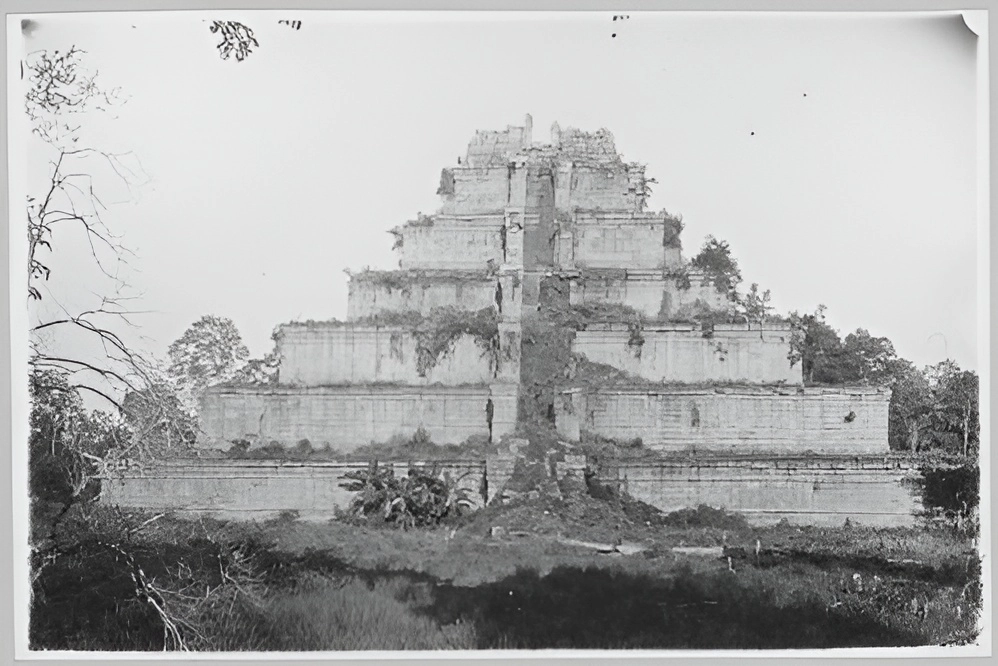

The capital of Koh Ker contains a total of 169 ancient sites, including 76 temples, human settlement areas, and ancient infrastructure such as road networks, irrigation systems, ponds, reservoirs, and dams. Prasat Prang (a tiered pyramid-shaped temple) served as the state temple, housing a 4-meter-tall Shiva linga named “Tribhuvanesvara.” Prasat Prang is the most prominent architectural structure at the Koh Ker site.
Other temples were built to house Shiva lingas and important statues that were large in scale, aesthetically beautiful, and dynamic. These include statues of Dancing Shiva, Brahma, Vishnu, as well as sculptures depicting the battle between the Pandavas and the Kauravas from the Mahabharata and scenes from the Reamker (Ramayana). Consequently, the artistic sculptures at Koh Ker are highly distinctive and were more advanced than those in the Angkor region during the same period. Koh Ker introduced new styles in architecture and sculpture that became significant elements of Khmer style. The sculptures and art of Koh Ker—both architectural carvings and free-standing statues—represent the innovation of ancient Khmer art.
The prominent characteristics of the Koh Ker archaeological site that are unique and distinct from previous periods consist of two main points: 1. Urban Planning and 2. Iconography.
1. Urban Planning There are three main aspects of urban planning that stand out as unique៖
The Layout of the State Temple: The state temple was the most important temple for the King, located at the center of the capital for religious ceremonies (the Devaraja cult). The layout of the state temple in Koh Ker differed from previous eras by featuring the tiered pyramid Prasat Prang to house the Devaraja linga. This was followed by Prasat Krahom, which housed a statue of Sadasiva with 5 faces and 10 arms, a large water reservoir, and five linga temples built facing the baray (reservoir). These concepts are found in early mythology of Shaivism, which the Khmers structured on the ground according to their own context.
Trimurti Layout: The arrangement of the temple layout in a Trimurti form at Koh Ker involved building separate individual temples: Prasat Prang for the Shiva linga, and two Prasat Banteay Pi Choan—one for Brahma and one for Vishnu.
Sacred Water System: In Hindu philosophy, sacred water is explained as water flowing from the heavens of the gods. When rain falls, it flows over Mount Kailash, the abode of Shiva, and a major water system—the Ganges River—brings this water from Mount Kailash to irrigate the earth.
2. Iconography Aside from the unique urban planning, the iconography at Koh Ker possesses three notable characteristics:
The sculptures in this style were carved much larger than in previous styles, increasing in size by three to four times. More specifically, these statues were carved from a single block of stone together with their pedestals, which was technically difficult as it required finding the center of gravity for balance. Additionally, most statues appear to be in motion, such as the statue of Bali fighting Sugriva or the Garuda statues from Prasat Prang.
Carving mythological stories as free-standing statues is a remarkable feature. Previously, mythological stories were mostly carved as low reliefs on temple walls, pediments, or lintels. At Koh Ker, major stories were carved as free-standing sculptures in space, such as the scene of Bhima fighting Duryodhana found at Prasat Chen, the scene of Bali fighting Sugriva, and the Dancing Shiva found at Prasat Krahom. These ideas later influenced the reign of King Jayavarman VII, who used the Churning of the Ocean of Milk story as a narrative in space in front of the five gates of Angkor Thom.
Another special feature of Koh Ker statues is the depiction of stories illustrating the heroism of the King, such as the Reamker and Mahabharata. We see free-standing carvings of these two stories at Prasat Chen, a temple dedicated to Vishnu. Through these carvings, King Jayavarman IV likely intended to showcase his own heroism in moving the capital from Angkor to Koh Ker and establishing unique architectural and urban systems.
The Koh Ker archaeological site was inscribed on the World Heritage List on September 17, 2023, in Riyadh, Kingdom of Saudi Arabia, during the 45th session of the UNESCO World Heritage Committee, based primarily on three criteria (including ii and iv) of outstanding universal value for world heritage.